


How to Defeat Anxiety
Nothing has happened yet. Your body just thinks it has.
Your 16-year-old is 40 minutes late and her location won't load. The doctor's office wants to go over your results in person. Your boss texts "Can you meet at 4?" and you spend the next seven hours living out the worst case. Stress is pressure around you. Anxiety is pressure within you, and it always starts with two words: what if.
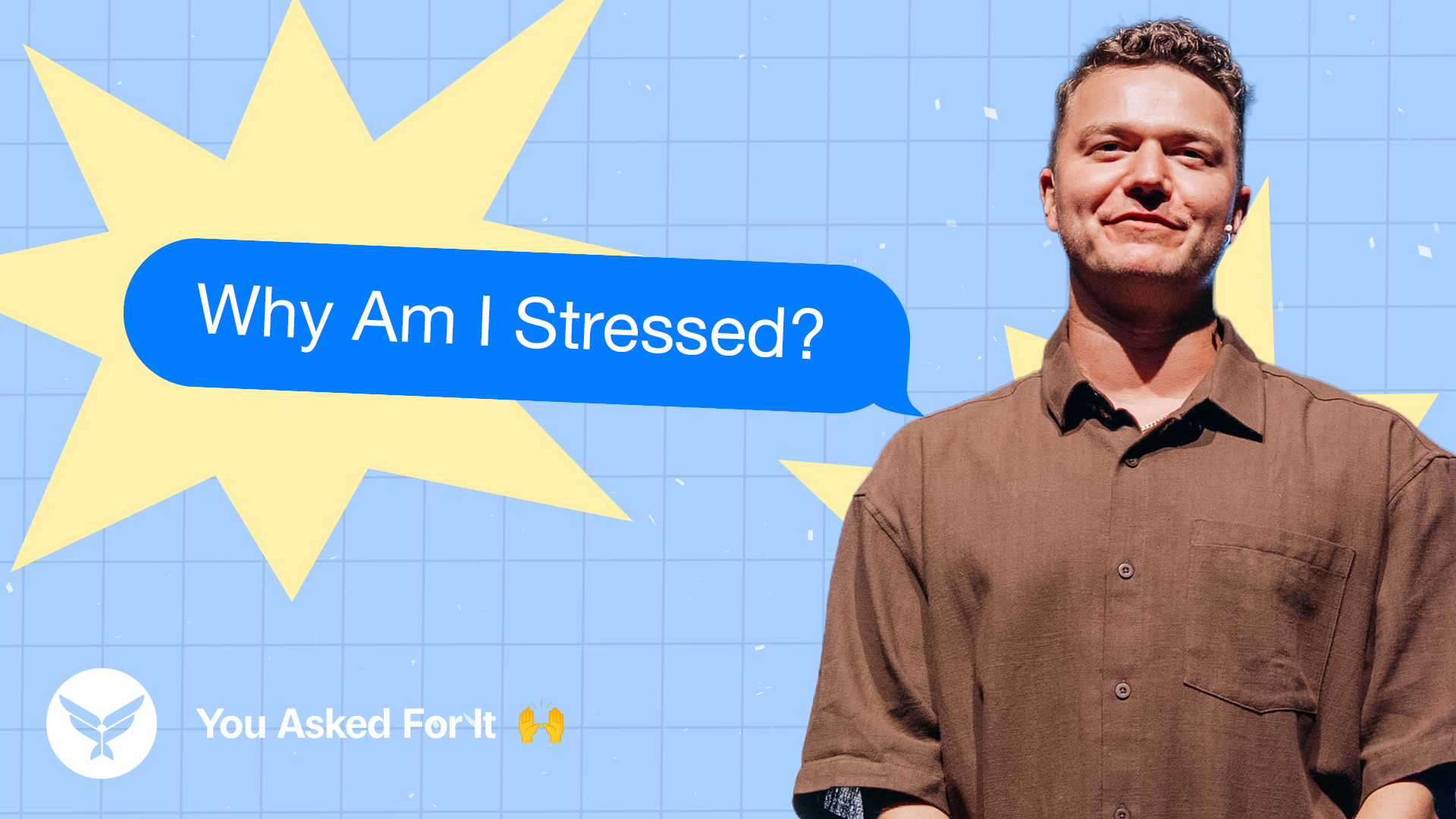
When we asked what you wanted to hear about, anxiety was near the top of the list. So in Week 3 of our series, You Asked For It, Brad opens the words Paul wrote from a prison cell, chained to a guard, not knowing if he'd live: "Do not be anxious about anything." With two buckets, a bag of ping-pong balls, and one very important word: but.
If you've ever lain awake at 2:47 a.m. rehearsing a conversation that hasn't happened, this is for you.
If you've ever been in the room with your kids but somewhere else in your head, this is for you.
And if you've ever been told a real Christian shouldn't feel this way, this is especially for you.
Because Jesus faced a tomorrow that wasn't a what-if. It was a what-is. And He walked right into it.
He drank His cup so you could cast yours.
Do today. Hand Him tomorrow.
For any person in this place who has been struggling with anxiety, I believe that God wants to come and give you what you need in order to defeat that thing. How many of you believe that you can actually live free from something like anxiety? You can actually step into the freedom that only God can give.
Some of you are well acquainted with anxiety. You feel it when you're going to bed at night and you think, "Man, I don't know if I can do tomorrow." That thing that keeps you up at night. That thing that can keep you physically present but mentally absent. Have you ever felt that, where you're in the room, but you're not actually in the room, because your mind is going everywhere else, saying, "God, are You going to come through for me in that thing?"
I think the hard thing is that stress can often be all around you. But anxiety is different, because anxiety isn't centered around everything that's around you. It's something that's in you. Sometimes something happens and it just gets into your soul. The what-ifs of life can get into your soul. What if my kids are not going to be okay? What if my job is not going to be okay? What if my business is not going to be okay? And sometimes it can get into your soul and make you sick.
I don't know what it is that you're experiencing, but I've come here today to say this: I believe that under the power of Jesus, you can be free from that thing. Jesus can set you free from whatever it is you walked in here with. So what I want to do today is talk about defeating anxiety.
What does the Bible say about anxiety?
To get some help, I'm calling on my brother Paul. If you have your Bible, turn to Philippians 4. Paul writes this entire letter from a prison. He is under guard. He is in chains. And from that place, he writes a letter to a church in Philippi that is going through immense persecution. He talks to them about various things, but one of the things he talks to them about is anxiety. It's kind of like his greatest hits. A lot of you know this verse.
Philippians 4:4: "Rejoice in the Lord always. I will say it again: Rejoice! Let your gentleness be evident to all. The Lord is near. Do not be anxious about anything." There's our verse. "But in every situation, by prayer and petition, with thanksgiving, present your requests to God. And the peace of God, which transcends all understanding, will guard your hearts and your minds in Christ Jesus. Finally, brothers and sisters, whatever is true, whatever is noble, whatever is right, whatever is pure, whatever is lovely, whatever is admirable, if anything is excellent or praiseworthy, think about such things. Whatever you have learned or received or heard from me, or seen in me, put it into practice. And the God of peace will be with you."
Be anxious for nothing. Turn to your neighbor and say, "Be anxious for nothing."
I think sometimes you can hear Paul say that and you're like, "Paul, that's really cute, but you don't pay my mortgage. That's really cute. You do not know my boss." And I think that's the significant thing about this passage. Paul isn't writing this from a beach. He is writing this from a prison. What he wants us to know is that we don't have to be anxious. So I want to talk about defeating anxiety in our lives today. Whatever it is that's on you, I pray in the name of Jesus it'll be sent off.
Lord God, I want to thank You for what You're doing. God, I pray that You will minister to Your people. Lord God, we are listening. We give this over to You, and in Your name we pray. Amen.
Anxiety feels like an elephant on your chest
I've got a confession for all of you here today, something many of you may not know about me. One of the things in my life that causes me the most anxiety is public speaking. You're all like, "Why are you in this job?" That's kind of weird for a pastor to admit. That's kind of like a lifeguard telling you, "Hey, just need to let you know something. Not a big fan of water. Just don't like it. It kind of gives me the creeps."
One of the greatest fears of my life has always been public speaking. And I think that's because if you actually knew me growing up, you would know I'm the least likely person to ever step on a stage. I am a hardcore introvert. I was homeschooled. I remember being in a small group, a Spirit Group, and there'd be six to eight of us there. My leader would ask me a question: "Brad, what do you think about that?" That's all they were getting from me. I never actually said anything.
I remember I had a youth leader who saw something in me, and he said, "Hey, here's what I need you to do. I need you to come preach a mini sermon." I was 16. And the moment he asked me to do that, I felt so much anxiety. I felt so much stress. I was like, "Man, I feel incapable. I don't know if I have what it takes." And when it came time for me to give that sermon, I was like this. You'd have thought, "Man, he's just passionate." No, it's because if I stood still, you would see my leg. As long as I walked, no one could see how terrified I was. It was awful. I got off that stage and I was like, "I'm done. This is terrible."
Seven years later, I was here in the States, and I got asked to preach at a large church. When it happened, I should have felt like, "Man, what an honor." But what actually happened is my heart sank into my feet. I was like, "Man, I don't know if I can do that. I don't think they know me like I know me." I felt so incapable, so inadequate. From the day I was asked to the day it happened, I had low-grade anxiety nonstop. It was almost like an elephant sat on my chest and I couldn't stop thinking about it. And at one level, it wasn't the people I was afraid of. It was God. What if I'm not enough? What if this doesn't work out?
That week came. Monday morning, my leader said, "Hey, let me hear your sermon." So I preached it, and he said, "Absolutely not." The next day I came in and gave him a different sermon, and he said, "Absolutely not." Wednesday I came in and gave him another sermon. Absolutely not. And I'm like, "Great. This is the first time in history that someone's going to be asked to preach and then be asked not to preach, because apparently I don't have what it takes." Thursday I said something that was kind of good, and he said, "Okay, let's run with that." I worked nonstop until I hit that stage Saturday night, preached the weekend, went home, and said, "I'm never doing that again. That was the worst thing ever." So much anxiety up until that moment.
I think a lot of you know what I'm talking about. Maybe it isn't attached to a microphone, but it's attached to something else. There's something right now that you feel anxious about. There's something in your life, something in your family, something in your workplace, and it feels like an elephant has sat on your chest. And you're like, "God, are You going to actually help me with this thing?"
You know that feeling. It's the feeling when your 16-year-old daughter is 40 minutes late for curfew and Find My says her location is nowhere to be found. It's the feeling you get when the doctor calls and says, "Hey, I need to go over these results with you in person." It's the feeling when your boss texts you at 9:00 a.m. and says, "Can we chat at 4:00?" And you're like, "Why would you do that to me? What are we talking about?" Then the bubbles come up, and then the bubbles disappear, and you're like, "Oh, I'm getting fired. That's exactly what's about to happen."
It's the feeling when your mortgage is going up in January and you're at the kitchen table late at night thinking, "I don't know if I can make these numbers fit." It's when you check the baby monitor six times, your kid has been fine all six times, but you're going to check it a seventh. Something is just sitting on your chest.
Why does anxiety always imagine the worst case?
Stress can often be around you. But the thing about anxiety, the thing that's so hard, is that it comes from within you, always playing out the worst-case scenario. What if this doesn't work? What if this doesn't happen? What if I fail? What will people think? What will my family think? What will that make me think about God?
Growing up, I watched a Pixar movie called Inside Out. Have you ever watched Inside Out? What a movie. If you watch it, you'll meet these characters. There's Joy. You get Disgust and you get Sadness, and then you get Fear. And can anyone guess what that little red guy is? Anger. He's just mad. The entire movie is about a girl named Riley. She has these emotions in her head, and they're all fighting for the control panel. When someone does something that makes her mad, Anger comes and starts driving. When she feels sad, Sadness comes and starts driving.
Then in Inside Out 2, Riley's a teenager, so you get introduced to all kinds of other emotions. And one of them you'll meet is this one. Can anyone guess her name? Anxiety. The entire movie, Anxiety is trying to take the control panel, and all she's doing is planning for what if. What if this doesn't happen? What if he doesn't say that? What if she does?
That's exactly what our minds do. That's what anxiety does within us. It's always planning: what if, what if? What if God doesn't come through? What if I struggle? And the worst part is that you're living something that has never happened as though it has, time and time again.
Is it possible to live an anxiety-free life?
And then you get well-meaning Christians who come up to you. You say, "Brother, I'm anxious." And they say, "Do you not know what the Bible says?" And I'm like, "Please tell me." "Well, brother, there's this verse the great Paul wrote: 'Rejoice! I will say it again: Rejoice! Let your gentleness be evident to all. The Lord is near. Do not be anxious about anything.' Brother, do you know what that means?" "No, please tell me." "Whatever you're anxious about, stop. Whatever that thing is that's bugging you, just stop."
And I just want to give you the right hand of fellowship in that moment. It can't be that easy. Have you ever read a verse and thought, "It can't be that easy"? Paul's like, "Don't be anxious." And you're like, "Great. How? You tell me, Paul. How? Have you seen my finances? Have you seen the economy? Have you seen the job market? How?" Sometimes we read parts of the Bible like that and we think, "Is this even possible? Is it even possible to actually live an anxiety-free life?"
Is counseling or medication a lack of faith?
Now, I need to say this: I'm no expert on anxiety. Some of you might have acute anxiety. You might have had trauma. If that's the case, I'm not an expert, and I actually recommend that some people get counseling for anxiety. I think sometimes pastors will say you shouldn't do that. But you need to know this: counseling is not a lack of faith. Medication is not a lack of faith. There are tools that God can use.
But what I do know is this: yes, anxiety can be physical, but most of the time it's spiritual. So today I want to talk to you about it from a spiritual perspective. How do we actually deal with anxiety from a spiritual perspective?
Is anxiety a sin?
Go deeper: Is Anxiety a Sin?
There are a couple of things I need you to understand. The first thing is this: anxiety is not always a malfunction of your mind, but it is a signal. If you feel anxious, if you feel stressed, you are not weak and you are not crazy, but your body is trying to tell you something. We said last week it's like the check engine light going off and saying, "Hey, you've got to do something here." If you're feeling it, it's a signal that something has to happen.
I think we fall into two extremes. The first extreme is that anxiety is always a sin. Has anyone ever told you this? "You do not have permission to feel anxiety." People will say, "If you just trust God, brother, the God who owns the cattle on a thousand hills, you will never have anxiety. And if you have anxiety, you're sinning." The only problem is that's not in the Bible.
Why? Paul had anxiety. 2 Corinthians 11:28: "Besides everything else, I face daily the pressure of my concern for all the churches." That word comes from the same Greek family as "do not be anxious." He's saying, "I feel concerned."
Did Jesus feel anxiety?
Not only did Paul feel concerned, Jesus felt concerned. In the Garden of Gethsemane, He was overwhelmed. He was distressed. Matthew 26:37–38 says He "began to be sorrowful and troubled. Then he said to them, 'My soul is overwhelmed with sorrow to the point of death.'"
And people will say, "Man, if you really trusted God, you would never be anxious." Really? Last I checked, Jesus is God. And I'm pretty sure Jesus trusts in Himself and in God. And if He trusts, then why is He overwhelmed?
Paul, in the same letter, Philippians 2:20, is talking about Timothy, and he says, "I have no one else like him, who will show genuine concern for your welfare." That is actually the exact same word in the Greek as anxiety. Do not be anxious. So in one place he says Timothy has genuine concern, and in another place he says, "Do not be concerned." What's the difference? One is a concern that is controlled, and the other is a concern that controls you.
So one extreme is that we think anxiety is a sin. The second extreme is this: "It's just who I am. I was born anxious. That emotion has always controlled me. It's my identity. It's literally who I am." No, no, no. The Bible doesn't say that either, because Paul says, "Do not be anxious about anything, but." Say "but." If there's a "but," that means we can do something about it.
How do you deal with anxiety as a Christian?
So I want to give you an anxiety audit, something you can use anytime you start feeling anxious. We're going to see it right from Philippians 4, and the more you practice it, the more you can actually step into freedom. Paul is going to help us with this. Verse 6: "Do not be anxious about anything, but in every situation." Say "every." Not some. "In every situation, by prayer and petition, with thanksgiving, present your requests to God."
1. Recognize what you're carrying
The first thing you need to do in order to deal with anxiety is recognize what you're carrying. He says, "in every situation." And my question is this: do you know your "every situation"? Do you actually know the things you are anxious about? Because how do you bring something to God that you do not recognize?
I have a bag of tricks here this week. What I have here is a bunch of ping-pong balls, and all of these ping-pong balls represent the anxious thoughts in your mind. There's a whole bunch of anxious thoughts, and they're often disguised as what-ifs. What if my money runs out? Anyone ever had that one? What if something bad happens? What if nothing happens? What if I'm behind? Here's another fear: what if I'm ahead of God? That's scary too. What if I'm sick? What if I missed it? What if I get fired? What if I fail my kids? What if it doesn't last? Anyone ever had those thoughts?
Some of you are like, "Brad, that's really cute, because that's not what my head looks like. My head actually looks like this." You've gone all the way to Costco and gotten a Costco delivery of anxiety. This is what life looks like. All of these thoughts are bouncing around in my head. So my question is this: what are you actually carrying? The hard thing is that so often in life, it's not just one thing I'm worried about. It's many things. And I'm like, "God, You can maybe deal with that one that just fell, but can You deal with this one that still exists in my head?"
We have all of these different kinds of fears. For me, one I struggled with was public speaking. Another one I've struggled with: what if this church succeeds? What if it fails? Here's the crazy thing. When I look at what God has done over this last year, we've seen 154 people baptized. To God be the glory. God is moving in a powerful way. There are people finding freedom. There are people getting connected in groups. There are people finding community and saying, "Man, I have found my best friends." The evidence tells me that's not the case. But what I've learned about anxiety is that anxiety doesn't care about evidence.
Everything in your life can be pointing to "God is on your side," and anxiety will say, "But what if He stops being on your side?" "No, up until this point He's been faithful in my business." "Yeah, but what if He stops?"
If I get to the thing beneath the thing, most of the time I'm not actually scared about the things I can take responsibility for. I can prep. I can study the Word. I can do what I need to do. What I can't do is make people get saved. I can do my best. I just can't make them do that. You're like, "I can show up to work faithfully every single day, doing what I need to do, praying, asking God to lead me. I can do that, but I can't control my success."
What I've noticed is that most of the time with anxiety, our problem is not that we can't take responsibility. Our problem is that we try to take sovereignty. We try to take God's job and take control of that thing. And whenever we try to take God's job, we feel anxious. God wants His job back.
What I've realized is that anxiety is actually just misplaced responsibility. You are responsible to parent your kids, but you cannot control what happens to them. You are responsible to steward your money, but you cannot control the economy. You are responsible to lead your family faithfully, but you cannot control how people respond. I have responsibility. I do not have sovereignty. And my anxiety will always show up whenever I try to carry the parts that only God can.
So here's my question: what are you actually carrying? Not the thing, but the thing beneath the thing. It wasn't actually public speaking that I was afraid of. It wasn't standing in front of you. It was the inadequacy I so often felt in my soul. "I'm worried I'll lose my job." Yeah, but that's not actually the thing you're worried about. The thing you're worried about is that if you lose your job, you'll fail your family. What are they going to think about you? And what does that tell you about what you think about God? It's never the thing. It's the thing beneath the thing.
So whenever you start feeling that anxiety, don't stop at the symptom. Go all the way to the root. What is it that you are actually afraid of? Because how can God take something off your plate that you can't even name? You can't release what you will not name.
2. Release what you can't control
Verse 6: "Do not be anxious about anything, but in every situation, by prayer and petition, with thanksgiving, present your requests to God." The first thing is that you have to recognize what you're actually carrying. The second thing is that you have to release what you can't control. Turn to your neighbor and say, "Release it."
How do we do this? By prayer. What is that? Talking to God. By petition. What is that? Making a request of God. And then he says, with thanksgiving. What is that? Remembering God's faithfulness. When we're handing stuff over to God, we're saying, "God, this is what I need. God, I'm asking this. But as I ask, I'm also remembering Your faithfulness in the past." And I come to a place where I realize that if He has been faithful before, He can be faithful again. If He's done it before, He can do it again. If He has healed them, He can heal you. He has the ability. We make requests by prayer and petition, with thanksgiving. You have to learn to release.
What part is mine and what part is God's?
So here's the question I want you to ask when it comes to releasing: what part is mine, and what part is God's? What part can I control, and what part can God control? What part of this belongs to me, and what part actually belongs to God?
I have all my ping-pong balls right over here, and I have two buckets. You like it? I've got a bag of tricks. One of them is called "Mine," and the other one is called "His." Not only do you have to recognize what you're carrying, you have to release the parts that aren't yours and hold on to the parts that are yours. For me, studying the Word and preaching faithfully: is that mine or God's? Mine. People getting saved: mine or God's? God's. You being faithful in your workplace: yours or God's? Yours. That thing growing, that thing succeeding: God's.
The problem comes when we get this messed up, and we either put everything in our bucket or we put everything in God's. I talk to people in the lobby and they say, "Brother, I'm looking for a job." "Praise God, man. Tell me, what are you doing?" "I'm praying." "That's a good start. What else are you doing?" "No, man. I'm just praying." "Have you done a résumé?" "No, that's Him." "Have you applied?" "No, no, no. That's Him." "Brad, I'm single." That's great. Have you gone out in public? "No, I'm in my house, and they're coming. They're just going to show up."
The problem is that when you put everything in God's bucket, you'll become even more anxious, because the money is running out and you won't even apply. The same thing happens when you put everything in your bucket. "Nope, I'm going to do that. The result is up to me. Whether God comes through is up to me. God, I think You're good, but have You seen my SAT scores? I've got this." And you're going to be anxious too.
You will always be anxious if, number one, you don't recognize what you're actually carrying, and number two, you don't decide to release what you need to release and hold on to what you need to hold on to. We have to come to the place where we understand that obedience is our job, but the outcome is His. Obedience is your job, but the outcome of that thing is His. Today's assignment is what God has called you to do. Tomorrow actually belongs to God.
That's why Jesus says in Matthew 6:27, "Can any one of you by worrying add a single hour to your life?" No, you can't. He says, "Look at the lilies, and how God provides for them." How much more will He provide for you, whom God actually loves? And then He ends it in verse 34: "Therefore do not worry about tomorrow, for tomorrow will worry about itself. Each day has enough trouble of its own." We can only do what God has called us to do today, and we have to release the part we can't control, which is tomorrow, to God.
What does it mean to cast your anxiety on God?
Peter says it this way. 1 Peter 5:6–7: "Humble yourselves, therefore, under God's mighty hand, that he may lift you up in due time. Cast all your anxiety on him because he cares for you." Say "all." Not some. That's not a polite little toss. He's saying, "No, throw everything onto God." Why? Because He cares. Your cares are not burdensome to God. He can carry them. You can't. And He invites you to literally throw it on Him. Cast it on Him.
For those of you who are Bible geeks and Bible nerds, I've got something for you. In the Greek grammar, this entire passage is actually one sentence: "Humble yourselves, therefore, under God's mighty hand, that he may lift you up in due time, casting all your anxiety on him because he cares for you." Casting is actually connected to humility. Let me say it this way: casting your anxiety is actually how you humble yourself. God wants someone who's humble, and the most humble thing you can do is say, "God, I can't."
I watched my dad do this in 2008. My dad's a real estate broker, and everything was crashing. Every single day he was facing bankruptcy. I asked him, "Dad, how did you do it?" And he said, "I did everything to the best of my ability. I got into bed at night and said, 'Lord, I have done everything I can. I have tried my best. I'm just going to trust that You have this, and I'm going to go to bed.'" I remember times when my dad said, "We need 10,000 rand by tomorrow." I said, "Dad, what are you going to do?" He said, "I have no idea." And we would wake up the next day, no one knew what we were going through, and someone had put 10,000 rand through the door. He said, "God, I can't do this. I've done my part. Can You do Yours?" That is actually how you humble yourself. And the Bible says that when you humble yourself under His hand, He will lift you up in due time.
I wonder what would happen in our lives if we moved from what-ifs to even-ifs, where we had that kind of trust in God. I'm reminded of Shadrach, Meshach, and Abednego in the book of Daniel. King Nebuchadnezzar puts up a golden statue and says, "Bow." And they say, "We won't." He says, "Great. I'm going to throw you into the fire." And they say, "Nebuchadnezzar, we need you to know something. Our God is able to deliver us, and He will deliver us. But even if He does not, we will not bow down to your gods."
What does that look like? My God is able. But even if He doesn't heal, He is still Healer. Even if He doesn't provide, He's Provider. Even if He doesn't do exactly what I want Him to do, He is good. He is God, and He is good at being God. Even-if faith.
We have to recognize the things we're carrying, the anxiety you're feeling, and then you have to release it. Release the right stuff to God. Carry the things you need to carry. And I love what he says happens when you release control: "And the peace of God, which transcends all understanding, will guard your hearts and your minds in Christ Jesus." Paul is writing this under guard. He has a physical person guarding him. And he says, "Here's what you need to do. Don't be anxious about anything, but in every situation, by prayer and petition, with thanksgiving, present your requests to God." And what will happen? It's like he's looking around, he sees the guard who is guarding him, and he says, "When you do that, the same way this guard is guarding me, God's peace will guard you. It will guard your mind. It will guard your heart."
When you give it to God and Satan comes and wants to say, "Hey, you're not good enough," you can say, "Hey, by the way, I gave that to God. I cast that over to God. You don't have to talk to me. You've got to talk to Him. He's the One who's defending me." And God says, "My peace is going to guard their hearts and guard their minds." But what you have to do is release it.
3. Replace what you're rehearsing
The challenge is that you can hear this and think, "Great, that's all I need to do. I just need to recognize and release." The problem, though, is that you can release something to God at 2:30 a.m. and pick that thing right back up at 2:35. Five minutes later you're like, "God, I'm picking that thing back up. You haven't done anything in five minutes, and I've got this." That's why it's not enough just to recognize and release. The third thing you need to do is replace what you're rehearsing.
Philippians 4:8 says, "Finally, brothers and sisters, whatever is true, whatever is noble, whatever is right, whatever is pure, whatever is lovely, whatever is admirable, if anything is excellent or praiseworthy, think about such things." Here's the question you need to ask yourself: what is actually true right now?
The problem is that anxiety rehearses. What if I lose my job? What if I lose my marriage? What if they don't forgive me? What if I'm alone forever? You've lived through it 20 times, but it hasn't actually happened once. The beautiful thing about every what-if is that there's a truth on the other side of that ping-pong ball. What if this fails? What if God provides? What if He blows your mind? What if I can't make that payment? Well, He's provided every month for you so far. What if they're mad at me? Or what if you apologize and He does something significant in that place? What is actually true? Because the Bible says you need to think about what is true, noble, right, pure, lovely, and admirable.
Notice this: he doesn't say to think about what is possible. Some of us are so good at thinking about what is possible. Anxiety is a bad prophet. In my anxious mind, I have died 400 times. "This is going to kill you. Oh no, that person's driving at you. They're going to kill you." I have literally died in my mind 400 times. Anxiety is a terrible prophet. It's predicted 400 of my funerals, and none of them have come true.
It doesn't say to think about what is possible or probable. It also doesn't say to think about what is positive. It says to think about what is true. In other words, you have to have a filter in your mind, so that the second an anxious ball comes bouncing around in your mind, before you let it settle, you ask that thought, "Are you true? Are you noble? Are you right?" Because if not, God's Word speaks a better word. "So I refuse to believe this, and I choose to believe this." You've got to replace it with something that is actually true.
He says, "with thanksgiving." What is thanksgiving? It's remembering what He has done in your past. That is also true. Think about how He's been faithful before. And watch this: every time we thank Him for yesterday, it gives us faith for tomorrow. So the way you're not going to pick that thing back up is that you're going to recognize, you're going to release, and then you're going to remind yourself. You're going to replace the lies with the truth.
4. Return to today's obedience
And the final thing I want you to do, once you've done all of that, is return to today's obedience. Philippians 4:9: "Whatever you have learned or received or heard from me, or seen in me, put it into practice. And the God of peace will be with you." So here's the question I want you to ask: what is the faithful step God has called me to take today? Put that into practice.
Because this is what he says. Verse 7: when we release, the peace of God will guard you. Verse 9: when we obey, the God of peace will be with you. Peace isn't only something God gives. It is who He is. And when we trust in Him, He comes with it.
Anxiety is always going to ask you to plan your entire future. But God is going to ask you to obey Him today. Just today. What about tomorrow? He'll be there tomorrow. What about the next day? He'll be there too. He's not asking about all of that. He's just saying, "Will you obey Me today?"
In the Old Testament, He taught the Israelites this time and time again. One of the ways He taught them was through manna, a food God gave them every single day. Exodus 16:19–20: "Then Moses said to them, 'No one is to keep any of it until morning.' However, some of them paid no attention to Moses." God says, "Don't worry about tomorrow," and they're like, "Yeah, I'm not going to do that. I'm going to keep worrying." "They kept part of it until morning, but it was full of maggots and began to smell. So Moses was angry with them." Tomorrow's bread, kept today, ended up getting worms. God doesn't give you tomorrow's grace today. He gives you tomorrow's grace tomorrow. So you get to trust Him with today. That's why Jesus says, "Give us today our daily bread." That's why He says, "Do not worry about tomorrow, for tomorrow will worry about itself."
So what's your faithful step today? Maybe it's to say sorry, to apologize, to actually have the conversation. Maybe the step you need to take is just to take a nap. Stop working so hard. Take a Sabbath. A Sabbath is an act of faith, because you're taking one day where you're not going to work, and you're saying, "God, I believe that if I give You this one day, You can do more with my six." It is literally an act of faith to take a Sabbath. But we don't do that. Why? "Because I've got it." No, you don't. You don't have to solve the next 10 days. You just have to solve today.
Forgive me, I've been struggling with my voice this week.
We have to come to a place where we recognize what we're carrying. We release by sorting what's ours and what's God's. We replace the lies with the truth. And then we decide to walk in today's grace today.
How I deal with my own anxiety
You don't know this, but backstage we have a sign that says, "It's a privilege to be on the stage. Thank You, God, for choosing me." Every service, before I walk out, I put my hand on that sign and I pray. I say, "Lord, I don't feel like I have what it takes. I'm anxious. I'm worried." I still get nervous. Why? Because I care. "But Lord, here's what I know. If You want anyone else to have this stage, they can have it. This is Your church. It isn't mine. But today You have called me, and today You have graced me. So today I walk in Your boldness. I walk in Your courage." And I come out.
What am I doing in that moment? I'm recognizing: "God, I feel inadequate." I'm releasing the part that's God's: "You can have this stage." And I'm replacing the lie with the truth: "But today You have called me." So I step out in confidence. How have I dealt with my anxiety? That's how: by recognizing what is God's and what is mine, and stepping into it.
He drank His cup so you could cast yours
The final thing I want to share is my favorite part of this scripture. Like I said, Paul wasn't writing this from a beach. He was writing it from a prison. Not only that, he was writing while he was waiting to find out if he was going to be executed. Philippians 1:20: "Christ will be exalted in my body, whether by life or by death." 1:21: "For to me, to live is Christ and to die is gain." 1:23: "I am torn between the two." 2:17: "But even if I am being poured out like a drink offering on the sacrifice and service coming from your faith." He was wrestling with the possibility of dying. And he said, "Do not be anxious about anything, but by prayer and petition, with thanksgiving, present your requests to God, and God's peace will guard your hearts and your minds in Christ Jesus." He was able to not be anxious in one of the most anxiety-filled situations there is.
I think I had a bad day, and Paul had a bad day. But there's a guy who had it worse. His name was Jesus. In the Garden of Gethsemane, Jesus was in such anguish. Luke 22:44 says, "And being in anguish, he prayed more earnestly, and his sweat was like drops of blood falling to the ground." You see, Jesus wasn't wrestling with a what-if. He was wrestling with a what-is. It wasn't "What if I go to the cross?" He knew He was going to the cross. And He said, "Father, if you are willing, take this cup from me." He's like, "Lord, Lord, if You can take it." And then He said, "Yet not my will, but yours be done." He said, "God, I know what You called Me to do, and I'm going to do it today."
You need to recognize this: we can cast our anxiety upon Him, but Jesus didn't get to cast His cup. He drank it. And He drank it so we can cast ours. He trusted God with the outcome, and He did the hardest thing any man has ever done. He took the sin and shame of the world and went to a cross. Obedience looked really tough, but the outcome was really, really beautiful. Because of that, we can be restored to relationship with the Father.
God wants His job back. He wants you to trust Him. Your anxiety will only go away when we get to a place where we say, "Jesus, teach me to live like You. Let me do what's mine, and let me trust God with the rest. Even if it doesn't look like what I wanted it to look like, I still believe that You are good, You are God, and You are good at being God." What the enemy thought he destroyed, what looked like a defeat, was actually the most beautiful victory. Hand it to Him.
Here are four questions you can ask yourself every single time you're faced with it. What are you carrying? What is yours, and what is God's? How can you replace that lie with truth? And how can I be obedient today?
Can I pray for you? Lord God, I want to thank You for every single person who's here. Lord, I don't know what they're facing. I don't know what they're struggling with, but You do. Lord, You know why they're here. You know the things that keep them up at night. God, I pray that they will have such faith in who You are. Lord, speak to them. Help them discern what's Yours and what's theirs, and bring such peace. May Your peace guard every single one of their hearts and their minds.
While you continue praying, I want to take a second and talk to anyone who has heard about this man, Jesus, who died for your sins, and the what-if is, "Man, I don't know if I'm good with God. I'm a million miles away from Him. I'm not following Him right now." The Bible says that every single one of us has made mistakes. We've sinned. But Jesus came to this earth. He died on a cross for your sins, and He was raised again from the dead so that we can have life. If you're here today and you want to give your life to Him, I want to encourage you to do that. We're going to pray a prayer, and I want all of us to pray it for those praying it for the very first time. Just repeat after me: "Dear Jesus, I believe that You're the Son of God and the Savior of the world. I believe You came to this earth, You died on a cross, and You were raised so that I can have life. I make You my Lord. I make You my Savior. In Jesus' name."
With every head bowed and every eye closed, if you prayed that for the very first time, I would love to celebrate with you. All I want you to do is lift up your hand, just wave at me, and say, "Brad, that's me." If you prayed that for the very first time, thank you. I see that. Thank you. I love that.
Other Resources
Speaker
Series
Topic
Scripture
Date
More from this series

How to Win Spiritual Warfare
Why Am I Stressed?
How to Defeat Anxiety